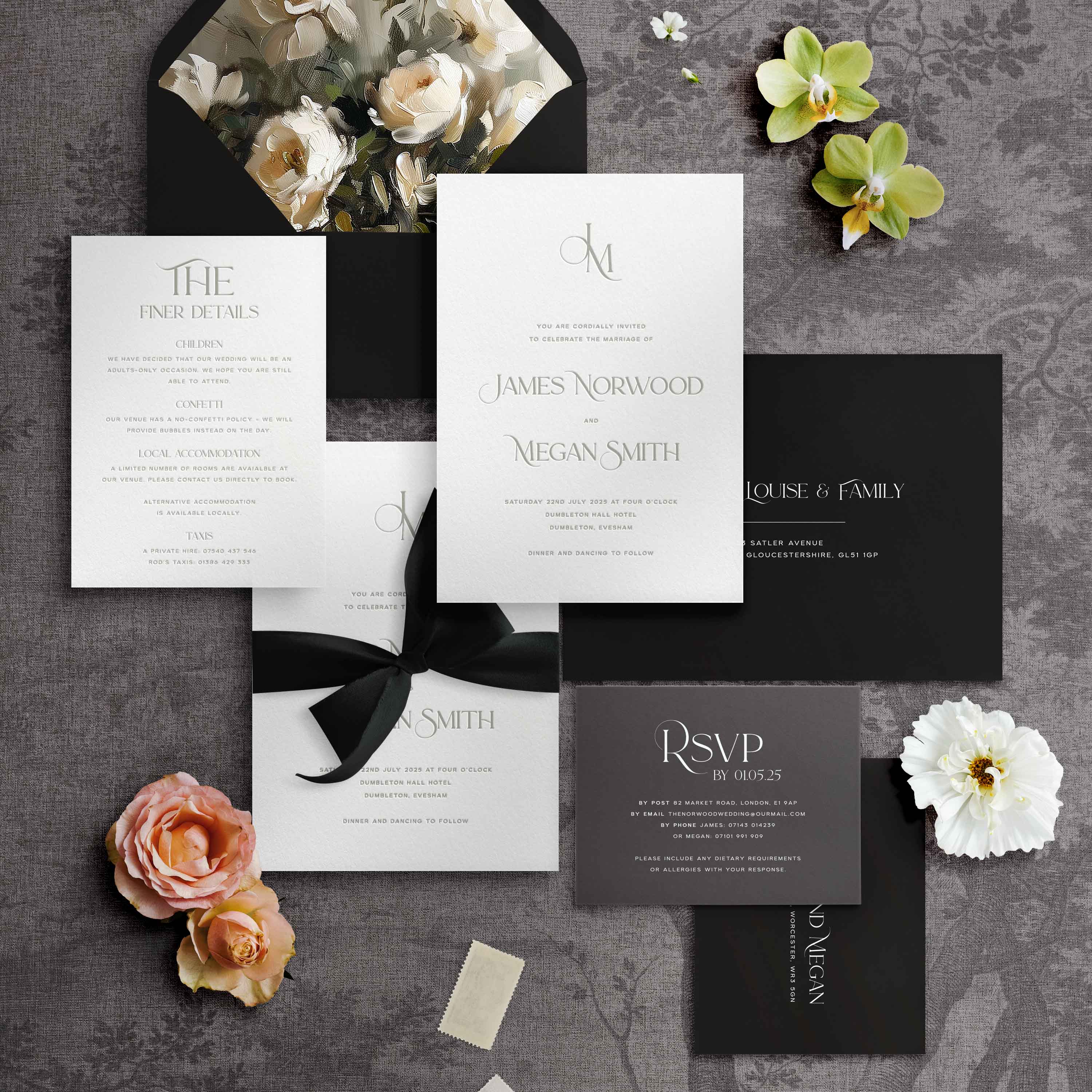

Wedding Invitation & Stationery Mistakes Couples Make (And How to Avoid Them)
After more than 13 years as a wedding stationer, I’ve seen my fair share of wedding invitation and stationery mistakes couples make when planning their big day.
In this guide, I’ll walk you through the 10 most common errors couples make when ordering their wedding stationery — and, more importantly, how to avoid them.
- Ordering Wedding Stationery too Late (Wedding Invitation Timeline Guide)
- Not ordering enough Invitations (How Many to Order)
- Skipping, or rushing, proof reading (Wedding Stationery Typos to Avoid)
- Choosing and focussing on style over readability
- Forgetting essential Wedding Invitation information
- Not thinking about postage early enough
- Ignoring Wedding Stationery Etiquette
- Trying to DIY everything without a plan (or back up plan)
- Not coordinating Stationery as a Suite
- Choosing the Cheapest Option without considering quality

1. Ordering Wedding Stationery Too Late (Wedding Invitation Timeline Guide)
When it comes to weddings, budget and time are two of the biggest considerations. Unfortunately, the wedding industry doesn’t always do a great job of clearly communicating when couples should order their wedding invitations. On top of this, many couples need time to save before they can invest in their stationery.
These two factors combined create one of the biggest challenges couples face when ordering wedding stationery: leaving it too late.
Proofing and printing timelines are often underestimated, largely because commercial print companies can produce designed invitations in a matter of days. A professional wedding stationer, however, takes a very different approach. Your stationery isn’t rushed — and a stationer will make sure that everything is just as it needs to be.
The proofing process alone can involve multiple rounds of amendments and back-and-forth communication. And then there’s the one factor everyone forgets: life. Work, family, illness, and other commitments can all slow response times, meaning proofs may not be approved for days — or even weeks.
Printing itself is not a simple or instant process. It takes time, testing, and experience to ensure correct alignment, accurate colours, crisp print quality, and flawless finishes. Each job requires careful setup, quality checks, and often hand assembly.
A professional wedding stationer will always take time over your invitations — and that’s exactly what you want when you’re investing in something so meaningful. Speed should never be the priority when it comes to wedding stationery. Here are when to order wedding invitations and stationery.
Understanding Stationery Timelines
Save the Dates are typically quicker to produce than Invitations, and Invitations are quicker than Day Stationery.
On average:
- Save the Dates take a couple of weeks
- Invitations take around 6 weeks
- Day Stationery can take anything up to a couple of months
It’s also important to allow time for mistakes, reprints, or last-minute address changes. Most stationers won’t have spare cardstock in sufficient quantities to cover mishaps — especially when specialist finishes such as letterpress or hot foil are involved.
How to Avoid This Mistake
To avoid delays and unnecessary stress:
Always check and recheck your proofs
Order slightly more than you need to allow for spares or invitations lost in the post
Ensure you’re working with the most up-to-date guest information
Another key factor to consider is your guests. Missed RSVP deadlines, confusion over details, difficulties accessing a wedding website, or stressful events in their own lives can all have a knock-on effect on responses and understanding.
Sending invitations around six months before the wedding allows ample time to resolve issues calmly and keeps stress to a minimum.
Top Tip: As a general guide, wedding invitations should be ordered several months earlier than most couples expect — allowing ample time for proofing, printing, and the unexpected.
Top Tip: Recommended Ordering Timeline
As a general guide, wedding stationery should be ordered several months earlier than most couples expect:
- Save the Dates
Ordered 13 months before the wedding
Sent 12 months before the wedding - Invitations
Ordered 8 months before the wedding
Sent 6 months before the wedding - Day Stationery
Ordered 2 months before the wedding
Printed 3 weeks before the wedding
You can also read our helpful guide on how and when to order your stationery here, our our Ordering Guide Page.
2. Not Ordering Enough Wedding Invitations (How Many to Order)
It can feel counter-intuitive — and even wasteful — to order more invitations than you think you’ll need. However, this is one of the most common (and costly) mistakes couples make when ordering their wedding stationery. But how do you know how many wedding invitations to order?
As professional printers, stationers work with minimum print quantities due to the time and expertise required to set up presses, whether that’s letterpress, hot foil, or digital printing. Unlike large commercial printers, stationers don’t hold unlimited spare stock. As a result, requesting additional invitations after your original order can be disproportionately expensive — and often leads couples to decide against sending extra invitations altogether.
Another important factor is how quantities are calculated. Throughout wedding planning, most suppliers require an exact guest count. Stationers don’t. We work by household, not individual guests.
This misunderstanding often causes unnecessary panic. For example, a wedding with 100 guests does not require 100 invitations.
How Invitation Quantities Are Calculated
Working out the numbers of invitations needed isn't rocket science, but where are wedding invitations quantities explained?
Well, Save the Dates and Invitations are usually worked out using the following formula:
Total guest count ÷ 2 (average household) + 10–15% spare
So, for 100 guests:
- 100 ÷ 2 = 50
- 50 + 10% spare = 55 invitations
This allowance accounts for:
- Last-minute guest additions
- Invitations lost in the post
- Address changes
- Human error
If further quantities are required later, there’s another risk beyond cost: consistency. Additional print runs may not match the original exactly. Colours, alignment, and even cardstock texture or shade can vary between batches.
While most stationers will over-order a small number of extra pieces for testing, these are rarely enough to produce a full additional invitation suite and should never be relied upon.
What to Do With Spare Invitations
Ordering extra invitations is rarely wasteful. Unused pieces often become some of the most meaningful keepsakes from your wedding:
- Keepsakes
Family members often ask for a copy to keep as a memento. - Flat lays for your photographer
Many photographers create styled flat lay images of your stationery alongside shoes, jewellery, perfume, or florals. This is a detail couples frequently forget — and regret later. - Memory boxes
Invitations and Save the Dates are often treasured items kept long after the wedding day itself.
Regardless of how intimate or party-focused your wedding is, not ordering enough invitations can create avoidable stress and unnecessary expense. Always speak to your stationer about their process and recommendations — but as a general rule, allowing an extra 10–15% is strongly advised.

3. Skipping Proofreading (Wedding Stationery Typos to Avoid)
Spelling and formatting errors are, without question, the number one cause of wedding stationery regrets. Over the years, we see the same wedding invitation spelling mistakes appear time and time again — often on pieces that have already gone to print.
Common Stationery Typos Couples Make
Accomodation - instead of Accommodation
Canapes - instead of Canapés
Pate - Instead of Pâté
Creme Brulee - instead of Crème Brûlée
Isle - instead of Aisle
Formatting Errors
13.00pm - instead of 13.00 OR 1pm
12pm - instead of 12am or Midnight
Addressing Errors
Incomplete Postcodes
Name Variations (Luci, Lucy / Katherine, Catherine / Geoff, Jeff)
Information Blindness
Couples often suffer from what we call information blindness. When you read the same text repeatedly, your brain starts to skim — filling in gaps rather than truly reading what’s in front of you. This makes it very easy to miss small but important errors.
For this reason, we always recommend sending your proofs to a trusted family member or friend for review. A fresh set of eyes will almost always spot something you’ve overlooked.
It’s also important not to rely on autocorrect. Spellcheck software frequently swaps British spellings for American ones (colour vs color, honour vs honor), which can easily slip through unnoticed.
Consistency Across Your Stationery
Proofreading isn’t just about spelling — it’s also about consistency. Formatting should match across all pieces of stationery. If you’re using names, dates, or decorative elements along the edges or borders, make sure they appear in exactly the same position and format on every item.
Small inconsistencies can stand out more than you expect once everything is printed and laid side by side.
How to Check Your Proofs Properly
When you receive a proof, take the time to read every piece slowly and line by line. Many couples find it helpful to read the text out loud to one another, as this can highlight errors, awkward phrasing, or sections that don’t flow naturally.
Once you’ve completed your own checks, send the proofs to a third party — not someone else involved in planning — for a final review. This layered approach gives you the best chance of catching mistakes before they become permanent.
For further help with wording you can learn more in our Invitation Wording Guides page
4. Focussing on Style over Readability
This can feel like a controversial topic, so it’s important to approach it with balance. Wedding invitations are the hero piece of your wedding stationery and one of the most common areas couples make mistakes with. They announce your wedding to your guests, they’re often the first physical item guests see, and they begin the process of creating memories of your day. They carry significant emotional weight.
That said, wedding invitations also have a very practical purpose — and good stationery should blend beauty and function.
While details such as font size, alignment, colour matching, and spacing are all important, they should never come at the expense of clarity. Wedding invitations have a lot to do. Above all else, they must clearly and accurately communicate essential information to your guests.
For this reason, invitations need to be readable, flow naturally, and provide clear instruction in the simplest way possible.
Font Choice Matters
Font styles and sizes should be one of your first considerations. Calligraphy or decorative fonts can be beautiful, but they must be legible — especially for body text.
Names are the most recognisable element on an invitation, so a decorative font can work well for headings or titles. However, the accompanying font used for key information should be clear and easy to read. Overly ornate or very small fonts can quickly become difficult for guests, particularly older ones.
In most cases, a clean, non-stylised font for important details works best. It creates contrast with decorative elements while ensuring information is instantly understood.
Colour and Contrast
Cardstock colour plays a significant role in readability. Large amounts of light text on a dark background are statistically harder to read than dark text on a lighter background. This is especially important to consider for inserts or information cards, and for guests with visual impairments.
High contrast doesn’t mean sacrificing style — it simply ensures your stationery works as intended.
Less Conversation, More Clarity
Another common issue is trying to include too much conversational wording. Many couples write their invitations as if they’re explaining things verbally, which can overcomplicate instructions, take up unnecessary space, and lead to confusion.
For example:
“Our venue is situated in the Cotswolds and is therefore rural, with the nearest town seven miles away. It is advisable to prebook taxis prior to the wedding date to make sure you have transport home…”
This can be simplified to:
“Please prebook taxis prior to the wedding date due to the rural location of our venue. Taxi details are available on our website.”
Removing conversational language makes information clearer, easier to scan, and far more effective.
Trust the Balance
When planning your invitations, aim for a balance between aesthetics and clarity. Both are equally important. It’s also worth trusting your stationer’s advice. Suggested edits aren’t about changing your vision — they’re about ensuring your information is communicated clearly and efficiently within a limited amount of space.
This approach can also help reduce the need for unnecessary inserts, save on printing costs, and prevent guests from being overwhelmed by large blocks of text — which often leads to skim reading and missed details such as RSVP deadlines.
5. Forgetting Essential Wedding Invitation Information
When couples spend a lot of time refining design details, it’s easy for essential information to slip through the cracks. While invitations don’t need to include everything, they do need to provide guests with the information they need to attend your wedding confidently and without confusion. So what information should be on a Wedding Invitation?
Missing RSVP Details
One of the most important actions a guest needs to take is to accept or decline your invitation. Providing a clear RSVP deadline is essential — not only does it set expectations for your guests, but it also gives you a definitive timeline for the rest of your wedding planning.
Without an RSVP date, it becomes difficult to:
- Confirm numbers with your venue or caterer
- Chase missing responses
- Finalise quantities for place cards, menus, and seating plans
Deciding on an RSVP deadline can feel difficult, which is why some couples avoid including one altogether. However, we recommend setting an RSVP date around three months before the wedding. This allows time for invitations to arrive, for guests to arrange logistics, and for you to follow up where needed — all without unnecessary stress.
No Dress Code or unclear expectations
While most guests know not to wear white, other expectations are not always obvious. Is your wedding relaxed or beach-based, where sandals and lighter clothing are appropriate? Is it a formal stately home wedding with a black-tie feel? Are there colours you’d prefer guests to avoid, or a palette you’d love them to embrace?
If you have any dress-related preferences, it’s always better to make them clear. Guests appreciate guidance, and clarity helps them feel comfortable and confident on the day.
Venue Address and Start Times
While the full venue address doesn’t need to appear on the main invitation, it should be clearly available on an information card or your wedding website — particularly if the venue is rural, difficult to find, or unfamiliar to your guests.
Your invitation should also clearly state:
- An arrival time
- A ceremony start time
This avoids confusion about when guests should arrive and ensures everyone is seated and ready at the right moment.
Don't assume Website will be looked at
Wedding websites are a brilliant tool and can handle a significant amount of logistical information, allowing your printed stationery to remain refined and uncluttered.
However, not all guests will automatically use a wedding website. Some may not notice it, while others may not feel comfortable navigating one. It’s important to clearly indicate that further information is available online — and what kind of information guests can expect to find there.
A brief summary on your stationery helps guide guests to the details most relevant to them.
What information belongs where?
Your invitations and website can share information, but they serve different purposes. Websites are ideal for detailed explanations, while printed stationery should provide information guests may need at a moment’s notice.
Relying solely on a website can be frustrating for guests if they need to scan a code, enter a password, and navigate multiple pages just to find a key detail.
Wedding Websites are best for:
- Menu choices and dietary requirements
- Gift wishes
- Social media policies
- Unplugged ceremony details
- Outdoor wedding guidance
- Accommodation information
- Taxi details
- Directions and parking restrictions
- Checkout or departure times
- Pet policies
- Multi-day event details
- Glamping or camping information
- Children’s menus
- Full itineraries
- Destination wedding details
Invitations are best used for:
- Names
- Date
- Arrival time
- Ceremony start time
- Venue name and area (not the full address)
- Finish time (e.g. “Carriages at midnight”)
Inserts are best used for:
- Transportation details
- Children policy
- Dress code or colour palette
- Confetti policy
- Cash-only or card-only bar information
- Full venue address
- QR code or link to your wedding website
- RSVP details (including digital RSVP instructions)
- Maps of extensive grounds
If you’re not opting for a wedding website, it’s important to carefully consider how much information you include. Modern invitations aren’t designed to hold large amounts of text, and guests don’t want to receive multiple loose inserts just to attend your wedding.
A balanced approach — combining thoughtfully designed invitations with a wedding website — allows information to be shared clearly, efficiently, and cost-effectively. Most wedding websites are free to use, making them both a practical and budget-friendly planning tool.

6. Not thinking about Postage early enough
Even if you plan to hand-deliver many of your invitations, it’s almost guaranteed that some will need to be posted. Postage is often overlooked during the design stage, but it should be factored into both your stationery choices and your overall budget.
In the UK, Royal Mail allows a standard letter to be up to 5mm thick, which typically covers a single invitation card, one insert, and an envelope. Adding additional inserts, belly bands, wax seals, or other embellishments can quickly push your invitation into the large letter category — increasing postage costs.
Delivery Times Matter
When planning your stationery timeline, delivery times are just as important as printing times.
While Royal Mail guidelines state:
- 1st Class: 1–2 business days
- 2nd Class: 3–4 business days
In reality, delivery can take longer. First Class post can take up to a week to arrive, and Second Class delivery can take nearly two weeks in some areas — particularly as Second Class mail is now delivered only two - three days per week.
These delays should be taken into account when deciding both when to order your invitations and when to send them out. Allowing extra time helps avoid unnecessary stress and ensures your guests receive their invitations when expected.
7. Ignoring Wedding Invitation Etiquette
Wedding invitation etiquette often gets a bad reputation for being outdated or overly formal. In reality, etiquette isn’t about rigid rules — it’s about clarity. When etiquette is overlooked, confusion quickly follows, and that’s when guests start making assumptions.
Most etiquette “mistakes” aren’t offensive; they’re simply unclear.
Addressing Envelopes Incorrectly
How you address wedding invitations plays a much bigger role than many couples realise. Guests use envelope wording to understand exactly who is invited, and ambiguity can lead to awkward conversations or unexpected plus-ones.
Common mistakes include:
- Addressing invitations to only one person when inviting a couple
- Guessing preferred names or nicknames
- Forgetting to clarify plus-ones
Addressing envelopes intentionally removes confusion before it even begins. If you’re unsure how someone prefers to be addressed, it’s always better to ask than assume.
Plus-One Etiquette
Plus-ones are one of the most common sources of confusion for guests. If it’s not clearly stated, guests may feel uncomfortable asking — or worse, make assumptions.
If a guest is invited with a partner or plus-one, this should be made clear either on the envelope or within the invitation itself. If they are not, leaving the invitation open-ended can unintentionally create awkwardness or disappointment.
Clear wording ensures everyone understands where they stand and allows you to plan accurately.
Children Policy
Whether or not children are invited, this is something that needs to be communicated clearly and sensitively. Many couples would have had this conversation with some guests before the invitations are sent out but without guidance, parents are often left unsure how to respond.
Addressing invitations only to the invited adults is often the simplest approach. If additional clarification is needed, this can be included on an insert or your wedding website using gentle, considerate wording.
Clarity here helps parents plan appropriately and avoids uncomfortable follow-up conversations.
Why Etiquette Still Matters
Good etiquette works quietly in the background. When done well, it:
- Reduces guest questions
- Prevents misunderstandings
- Supports accurate planning
- Makes guests feel considered and informed
Ignoring etiquette often results in extra emails, awkward clarifications, and avoidable stress — all things no couple needs during wedding planning.
Wedding invitation etiquette isn’t about being traditional for tradition’s sake. It’s about communicating clearly, setting expectations, and creating a smooth experience for both you and your guests.
If something feels unclear on paper, it will almost always be unclear to your guests too — and that’s where etiquette earns its place.
8. Trying to DIY Everything Without a Plan (or a back up)
DIY wedding stationery takes far more time than most couples expect. It also requires the right tools to manage that time, along with a certain level of skill. Underestimating any one of these elements often leads to unnecessary stress — particularly as the wedding date approaches. And the most commonly asked question is: Is DIY Wedding Stationery Worth it?
A popular example is the Cricut machine, which many couples turn to for DIY wedding projects. While it’s a versatile tool, it’s important to understand its limitations. The machine alone costs close to £300, has a maximum cutting size of 30cm x 30cm, requires different mats for different materials, and needs regular blade changes. Before you’ve even started, a significant investment has already been made.
Once you factor in ink, printers, additional tools, and cardstock, costs quickly add up. In fact, one of our professionally printed wedding invitation suites for 100 guests often costs less than the machine alone. DIY stationery is not always the cheaper option it first appears to be.
While home printers are widely available and inexpensive, they are inherently limited. Printers bought from supermarkets or office supply stores are not designed to handle specialist papers, heavier cardstocks, or large print runs consistently. Professional printing equipment simply isn’t available to purchase online, and expecting DIY tools to produce the same results is unrealistic.
Beyond print quality, the biggest issue with DIY stationery is inconsistency. Even professional printers include disclaimers for batch variation between print runs. A domestic machine — no matter how carefully used — will not perform better. Variations in colour, alignment, and finish are common, especially across multiple sessions.
As the wedding date draws closer, demands on your time naturally increase. Adding troubleshooting printer issues, recalibrating cutting machines, or reprinting misaligned pieces often becomes overwhelming. At that stage, there’s rarely the time — or mental space — to resolve technical problems calmly.
When DIY works well, it can be a wonderful option. However, it should always be approached with a realistic understanding of time, cost, and skill — and ideally with a professional stationer as a backup plan. Things can go wrong at any stage, and last-minute rush orders are always more expensive. Designing, printing, and assembling stationery takes both time and money, and that should never be underestimated.
Unnecessary stress close to your wedding day is rarely worth saving a small amount of money.

9. Not coordinating stationery through your day
This point largely comes down to personal preference, but many couples do prefer their stationery to feel cohesive throughout the day. Not only does this make it easier to align all elements visually, but it also creates a more tailored overall look.
The biggest missed opportunity is usually day stationery. Some stationery companies only offer invitations and save the dates, while others focus solely on large signage and nothing else. As a result, couples often end up sourcing pieces from multiple suppliers, which can make consistency difficult to achieve.
Choosing a stationer who offers a complete stationery suite can save a significant amount of time and stress — and in some cases, money, particularly if bundled pricing is available.
The key to creating a cohesive stationery look is planning early. Once you have a venue and a date confirmed, it’s worth looking into a stationer at the same time as your photographer, cake maker, florist, and other key suppliers. None of these should be left until the last minute, and stationery is no exception if you want everything to work together seamlessly.
10. Choosing the Cheapest Option Without Considering Quality
As a stationer, this is the point that resonates with me most. It’s easy to assume that a large commercial printer — producing hundreds of thousands of items a week — will give the same level of care and attention to an individual wedding stationery order. In reality, professional stationers approach quality very differently.
A professional stationer will have spent years researching and testing hundreds of different papers and cardstocks to find the right balance of quality, thickness, texture, and print performance. Stationers who print in-house (as we do) often have access to a far wider and higher-quality range of cardstocks than those typically offered by commercial printers.
For example, we use one of the UK’s highest-quality coloured cardstocks, which gram for gram is among the thickest available. After extensive testing, we’ve selected papers that offer enough texture to add depth and interest, without being so textured that print quality is compromised. This is particularly important when working across multiple printing methods, each of which produces a different finish. Our card and paper stock are therefore the best paper types for wedding invitations.
Another key difference lies in how colour is achieved. Commercial printers often create coloured backgrounds using ink printed onto white cardstock. Professional stationers, by contrast, use coloured cardstock itself. The result is a more reliable, richer finish and noticeably better print quality.
Ultimately, it’s worth asking whether achieving an exact ink colour match is worth compromising on the overall quality and feel of your stationery. In most cases, guests won’t notice if the shade of pink on your invitation doesn’t perfectly match your napkins — but they will notice if an invitation bends easily in their hands.
Durability is another important consideration. Save the dates and invitations typically travel through the postal system and need to withstand automated handling. Day stationery is often on display for 12 hours or more and needs to hold its shape throughout the day. Lower-quality materials tend to show signs of wear very quickly under these conditions.
There’s little benefit in spending hours designing or assembling stationery if it arrives looking damaged or worn. Quality materials ensure your stationery looks just as good in your guests’ hands as it did when it left the studio.
If your budget doesn’t stretch to professional stationery for every element, there are still thoughtful ways to balance cost and quality. Digital save the dates designed by a professional can be matched to your printed stationery. A wedding website can handle much of the logistical information, allowing you to simplify printed pieces. Invitation suites can be streamlined with a single insert and coloured envelopes, and signage can be combined to reduce the number of printed boards.
Most importantly, speak openly with your stationer about your budget and priorities. A good stationer will help you make informed choices without compromising on quality. While it’s easy to assume lower-quality materials won’t be noticeable, in practice they almost always are.
Final Thoughts
Wedding stationery mistakes are far more common than couples realise, and in most cases they’re entirely avoidable with the right planning and guidance. Nearly all of the issues discussed come down to time, clarity, and communication — not poor decisions or bad taste. Wedding stationery plays a dual role: it’s both a meaningful keepsake and a practical tool for guiding your guests through the day. Approaching it early, thinking carefully about how information is presented, and being open to professional advice can make the entire process far more enjoyable and far less stressful. With thoughtful planning and a clear understanding of priorities, wedding stationery becomes one of the most personal and noticeable elements of your wedding, rather than a last-minute concern.